English
 Italian
 German
 French
THE FOOD TRUCK IS CHANGING. AND STREETFOODY EVOLVES WITH IT.
The way a food truck is designed is changing. And the clearest sign of that comes not from numbers, but from the requests of those who will use it.
More and more often, new projects bring up topics like energy autonomy, consumption, storage systems, new powertrains and materials built to last. Requirements that were less central just a few years ago are now increasingly part of every design brief.
We see it in our own work: this year we recorded a growth of around 30% in requests related to energy efficiency, autonomy and vehicle sustainability.
For us, that figure means one thing above all: the market is changing, and with it the needs of those who choose a food truck.
That is why we keep experimenting, adapting and integrating new solutions — not to chase a trend, but to build vehicles that are increasingly suited to the way they are actually used today.
ENERGY BECOMES PART OF THE DESIGN
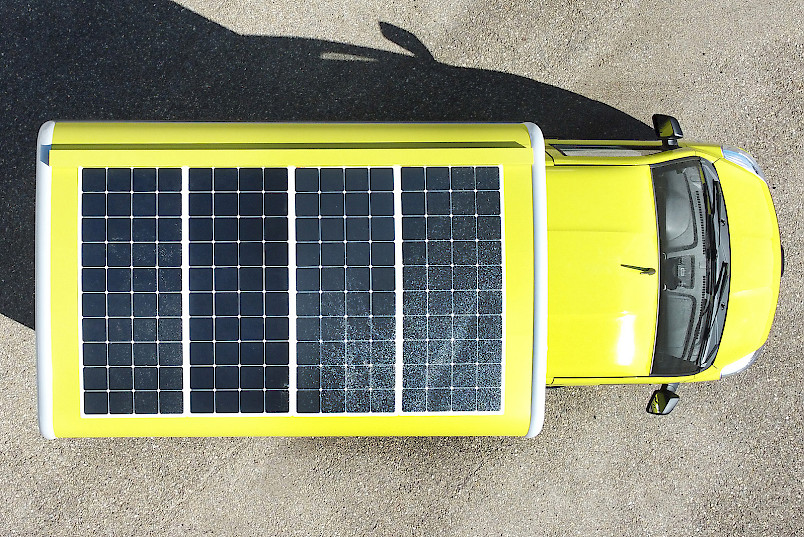
Photovoltaic panels and storage systems are now an integral part of many of our designs. Depending on the requirements, this can mean integrating solar panels and batteries, or developing specific solutions to make better use of the energy already available on board.
A concrete example is the systems that power refrigeration during travel, keeping food at the correct temperature even while moving. It is a practical way to increase the vehicle's autonomy and reduce dependence on external power sources.
In this sense, energy is no longer simply something the vehicle consumes: it becomes a resource to be produced and managed.
NPE OYSTER: ELECTRIC ON THE ROAD
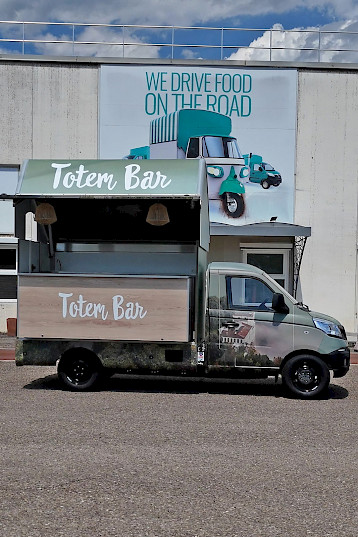
The evolution also concerns the powertrain. With NPE Oyster we chose to bring 100% electric propulsion into the world of mobile catering — developed on a Piaggio base and integrated into our design to meet the specific needs of a professional food truck.
NPE Oyster is already on the road: chosen, delivered, in use. This is an important milestone because it allows us to compare electric technology not only against theoretical design, but against the real experience of those who work with a food truck every day — with their requirements for range, charging and performance in service. Electric is not the right solution for everyone, and we say that not as a caveat but as a fact. It is, however, a concrete option that we are now able to design, build and propose.
BUILDING TO LAST
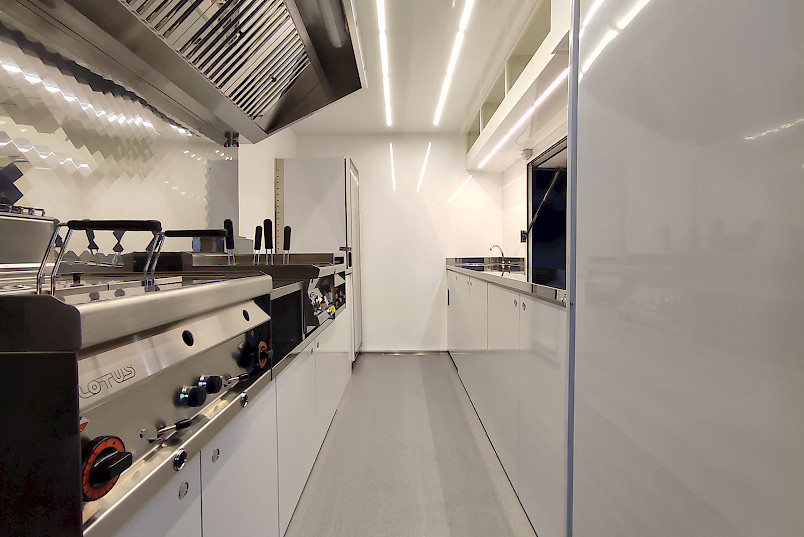
The evolution also concerns the way we choose to build. We work with durable and resilient materials and, where the project allows, we use recycled or recyclable materials. But there is one aspect that perhaps has an even greater impact on long-term sustainability: modular design.
A food truck can accompany a business for many years. In the meantime, the menu, equipment, production needs or even the type of service can change. Thinking in a modular way means the vehicle can be updated and modified over time. Less waste, more continuity. It is a concrete form of sustainability that starts at the design stage.
THE SAME APPROACH, INTERNALLY TOO
What we develop for our clients we also apply to our own spaces. Our showroom has been completely converted with a remote lighting management and control system: monitored consumption, programmable usage, remote intervention. It is not simply a technology upgrade — it is a different way of managing a workspace, with greater awareness of the resources we use every day.
For StreetFoody, innovating does not mean chasing every new technology. It means understanding which changes can truly improve the work of those who choose a food truck, and turning them into something concrete. The sector is changing — we see it in the requests we receive, in the projects we develop, in the vehicles we deliver. And that is exactly where we want to keep being.